
Sarvam Token Factory Pricing, Tested: What a Telugu Page and a Correct Answer Actually Cost
We measured Sarvam Token Factory pricing per Telugu page, per correct answer and latency from India, against GLM, Gemma, DeepSeek and GPT-6 Luna.
Sarvam Token Factory pricing starts at ₹10 per million input tokens and ₹25 per million output tokens for Sarvam 105B, according to Sarvam's own pricing page. That is a price per million tokens. Buyers pay per page and per task, so on 23 and 24 November 2026 we measured three things against Sarvam 105B, three open-weight models Sarvam hosts, and GPT-6 Luna: billed tokens per word in six Indian languages, rupees per 1,000 correct answers, and latency from India.
On Indian-language input, Sarvam 105B is 3 to 7 times cheaper than the other models on Sarvam's platform and level with GPT-6 Luna. Its default settings can cost 8 times more than its price card suggests, because reasoning tokens are billed as output. Every script and CSV is public in the full benchmark report.
Last updated 25 November 2026. Measured from India on 23 and 24 November. Prices are list prices at that time, and the exchange rate used for Luna is our assumption.
What does Sarvam Token Factory pricing look like across models?
Sarvam hosts its own Sarvam 105B alongside open-weight models, and the list prices differ by about 12 times on input. These are the figures on Sarvam's pricing page when we checked it on 23 November 2026, in rupees per million tokens.
| Model | Input | Cached input | Output |
|---|---|---|---|
| Sarvam 105B (introductory) | ₹10 | ₹0.25 | ₹25 |
| DeepSeek V4.1 Flash (introductory) | ₹14 | ₹0.25 | ₹55 |
| GLM 5.3 Flash | ₹13.5 | ₹2.5 | ₹45 |
| Gemma 4 | ₹35 | ₹10 | ₹90 |
| GLM 5.3 | ₹126 | ₹20 | ₹390 |
Sarvam says its introductory prices run through the end of 2026 and did not publish the prices that follow. Treat every rupee figure below as valid until then.
What does Sarvam Token Factory cost per Telugu page?
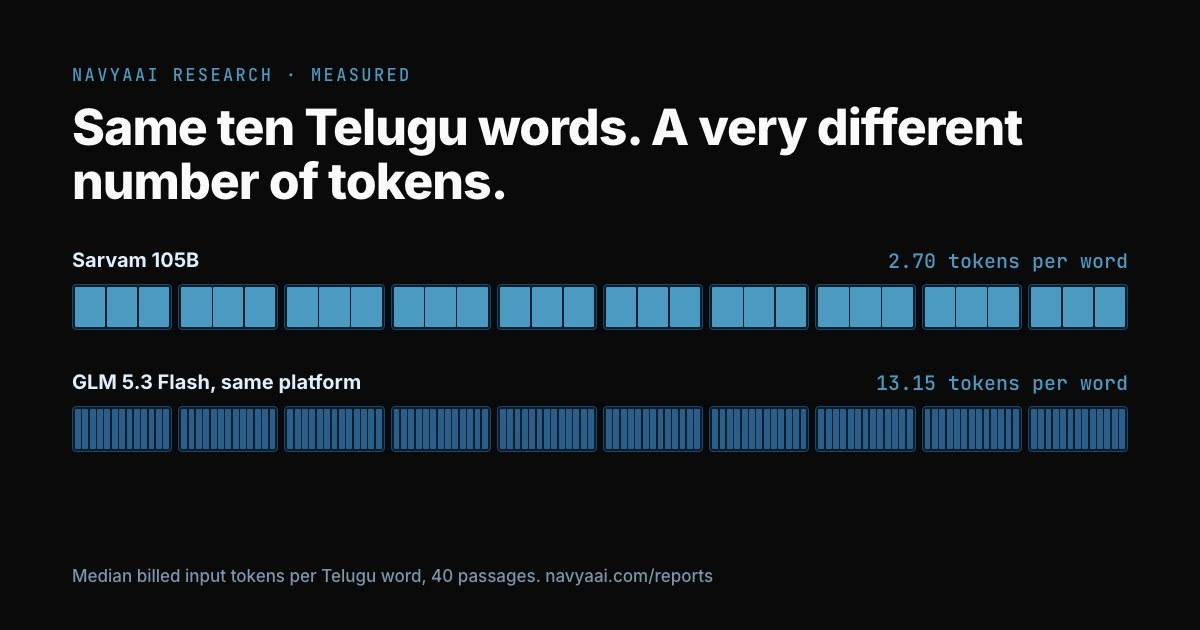
A Telugu page costs about ₹0.027 per 1,000 words of input on Sarvam 105B, against about ₹0.084 on DeepSeek V4.1 Flash and about ₹0.178 on GLM 5.3 Flash, both hosted on the same Sarvam API. We got these figures from the provider's own billed prompt-token count (usage.prompt_tokens) on 40 Wikipedia passages of about 120 words per language, with chat-template overhead subtracted (fertility.csv).
The gap comes from tokenizers, not from list prices. Sarvam 105B billed a median 2.70 tokens per Telugu word. DeepSeek V4.1 Flash billed 5.98 and GLM 5.3 Flash billed 13.15. GLM 5.3 Flash's ₹13.5 input price is close to Sarvam's ₹10, but a Telugu page costs roughly 6.6 times more on it, because the same words become many more tokens.
| Median billed tokens per word | Sarvam 105B | GPT-6 Luna | DeepSeek V4.1 Flash | GLM 5.3 Flash |
|---|---|---|---|---|
| English | 1.31 | 1.29 | 1.30 | 1.31 |
| Hindi | 1.49 | 1.79 | 2.97 | 4.75 |
| Bengali | 1.61 | 2.48 | 3.03 | 7.10 |
| Marathi | 2.08 | 2.60 | 4.32 | 6.49 |
| Tamil | 2.55 | 3.33 | 5.11 | 12.70 |
| Kannada | 2.62 | 3.30 | 6.09 | 14.10 |
| Telugu | 2.70 | 3.29 | 5.98 | 13.15 |
Is Sarvam cheaper than GPT-6 Luna for Indian languages?
On input it is level. GPT-6 Luna bills 3.29 tokens per Telugu word in our run, which is worse than Sarvam's 2.70, but Luna's input price is $0.10 per million tokens on OpenAI's pricing page. That works out to about $0.00033 per 1,000 Telugu words, or about ₹0.029 at ₹88 per US dollar, an exchange rate we assumed on 24 November 2026. Sarvam's ₹0.027 is within a few percent of that, so the exchange rate decides which one looks cheaper.
Output is a separate question. Sarvam lists ₹25 per million output tokens and Luna lists $0.50, about ₹44 at the same rate. We did not measure output tokens per language, so we make no claim about Indic output cost. Our LLM API pricing comparison tracks the US list prices we used.
Why can Sarvam 105B cost 8 times more per correct answer?
Reasoning tokens are billed as output. Sarvam's docs say so, and our run shows the effect. We classified 200 labelled AG News headlines into four topics, twice per configuration, at temperature 0 with a 4,096-token limit so reasoning could not truncate the answer (accuracy-raw.csv).
With default settings, Sarvam 105B produced about 440 to 450 output tokens per call on average, nearly all of them reasoning, to answer with one word. With reasoning switched off it produced 2.2. The cost per 1,000 correct answers was ₹14.5 on defaults and ₹1.78 with reasoning off, at 84.5% to 88.0% accuracy against 84.0%.
| Configuration | Accuracy, pass 1 and 2 | Output tokens per call | ₹ per 1,000 correct |
|---|---|---|---|
| Sarvam 105B, reasoning off | 84.0%, 84.0% | 2.2 | 1.78 |
| Sarvam 105B, default | 88.0%, 84.5% | 451, 437 | 14.5 |
| GLM 5.3 Flash | 91.0%, 89.5% | about 11 | 2.56 to 2.63 |
| GPT-6 Luna | 87.5%, 85.5% | about 26 | 2.60 to 2.72 |
| Gemma 4 | 87.0%, 86.5% | 2.2 | 5.94 to 5.98 |
| DeepSeek V4.1 Flash | 86.0%, 87.0% | 56 to 62 | 6.09 to 6.57 |
Read the accuracy column with care. With 200 cases the standard error is about 2.4 points, and two passes of the same configuration differed by up to 3.5 points, so most accuracy gaps here are noise. The cost gaps are large and repeated across both passes. This is one English task and says nothing about Indic accuracy.
How fast is Sarvam Token Factory from India?
For a single request, Sarvam 105B with reasoning off returned its first token in a median 0.14 seconds at midnight IST and 0.19 seconds at about 11:20 IST. Decode speed was 368 tokens per second in the first run and 237 in the second. Sarvam's own figure is about 330 tokens per second, so the claim reproduced once and not the other time (latency-pass1-raw.csv, latency-raw-pass2.csv).
GPT-6 Luna's first visible token took about 2.7 seconds in both runs from the same machine, and DeepSeek V4.1 Flash took between 1.4 and 2.6 seconds. Those two reason before they answer, so their first-token time includes thinking time.
At 32 concurrent requests Sarvam 105B's first-token time was 2.26 seconds in one run and 0.32 seconds in the other, so we do not quote a single figure for it. We also expected HTTP 429 rate-limit errors at that level, since Sarvam's docs list 50 to 60 requests per minute on pay-as-you-go, and saw none in 406 requests.
What did we get wrong the first time?
Our first latency pass divided all completion tokens, reasoning tokens included, by the time after the first visible token. For models that reason before they answer, that inflated tokens per second: DeepSeek V4.1 Flash showed 682 tokens per second at 32 concurrent requests, which is not a real decode speed. We marked those pass-1 figures invalid and re-ran with visible tokens only. Ten pass-1 requests also failed with connection resets or one timeout, mostly against OpenAI. We believe that was our network and do not count it against any provider.
What does caching do to the Sarvam input price?
Sarvam lists Sarvam 105B at ₹10 per million uncached input tokens and ₹0.25 per million cached input tokens. The blended input price is 10 × (1 − h) + 0.25 × h, where h is the share of input tokens served from cache. That gives ₹5.13 at a 50% hit rate and ₹0.71 at 95%. This is arithmetic on list prices, not a measurement, and we did not find Sarvam's cache scope or lifetime documented.
What does Sarvam say about data staying in India?
Sarvam's Token Factory page says inference runs on Sarvam-operated GPUs in India, and its Trust Center names Yotta and NxtGen as the infrastructure operators. Its own pages disagree on some details, so check them before you rely on any line. The developer docs say workspace data is retained indefinitely until an owner sets a period, while the privacy policy gives 30 days after last access as the default. The privacy policy also says content may be used to train Sarvam's models unless you opt out. Ask for the customer-API terms in writing.
What should you do before you pick a model?
- Measure billed tokens on your own text. Run 40 passages of your real data through each candidate's
usage.prompt_tokens. A cheap per-token price can sit behind a tokenizer that bills 5 to 13 tokens per Telugu word. - Turn reasoning off for classification, extraction and other short tasks, then check accuracy on your own labelled set.
- Compare cost per correct answer, not cost per million tokens.
- Re-check prices in January. Sarvam's introductory pricing runs through the end of 2026, and post-introductory prices were not published when we measured.
If you want these checks run on your own usage, our free AI inference audit looks at reasoning settings, tokenizer choice and caching. If you are weighing hosted APIs against running models yourself, see self-hosting an LLM vs paying for an API.
FAQ
Common questions
How much does Sarvam Token Factory cost?
Sarvam 105B is listed at ₹10 per million input tokens, ₹0.25 per million cached input tokens and ₹25 per million output tokens. Sarvam describes this as an introductory price that runs through the end of 2026, and the other hosted models cost more, for example ₹14 / ₹55 for DeepSeek V4.1 Flash and ₹35 / ₹90 for Gemma 4 (Sarvam pricing page, checked 23 November 2026).
Which Indian language is cheapest on Sarvam 105B?
Hindi, at a median 1.49 billed tokens per word, followed by Bengali at 1.61. Telugu was the most expensive of the six languages we tested at 2.70 tokens per word, which is still about 2.1 times English at 1.31. Measured on 40 Wikipedia passages per language.
Is Sarvam 105B more accurate than GPT-6 Luna?
We cannot say. On 200 labelled English news headlines the accuracy gaps between models were within noise (standard error about 2.4 points), and we did not test accuracy in Indian languages.
Does Sarvam really run at 330 tokens per second?
In our two runs from India, a single request to Sarvam 105B with reasoning off decoded at 368 and 237 tokens per second, so Sarvam's own figure of about 330 held in the midnight run and not in the 11:20 IST run.
Related
Keep going
Sarvam Token Factory benchmark report
All three measurements, scripts and raw CSVs.
OpenLLM API pricing comparison
US list prices for OpenAI, Anthropic and Google, re-verified November 2026.
OpenSelf-host an LLM vs pay for an API
Where a hosted API stops being the cheaper option.
OpenAI inference audit
Check your own usage for reasoning, tokenizer and caching costs.
Open