

Measure the real workflow cost
Separate model invoices from retrieval, retries, orchestration, observability, idle capacity, and engineering overhead.
NavyaAI audits AI spend, token volume, GPU utilization, RAG overhead, and agentic workflow cost so CTOs and ML platform leads can decide when to keep using APIs, optimize inference, or self-host.
Trusted by Innovative Companies


Compare managed APIs, inference tuning, and private deployments with the cost, latency, security, and operations tradeoffs on the table.
Separate model invoices from retrieval, retries, orchestration, observability, idle capacity, and engineering overhead.
Check whether caching, batching, prompt compression, routing, quantization, or GPU utilization can reduce spend first.
Compare API, hybrid, cloud GPU, and on-prem paths against latency, security, governance, and operating burden.
Field reports for operators who care about margin, reliability, and the real economics behind production AI systems.
New Report
A data-first look at token price collapse, hyperscaler capex, provider margins, hidden AI costs, and whether cheap token pricing can last.
Includes the 99.7% token cost drop, $725B AI capex signal, margin risk, and builder guidance for 2026.
Live Now
A 4-part breakdown of the cost paradox: 99.7% token price drop, 3× bill growth, and 72% spend hiding outside inference.
Includes benchmark numbers, hidden-cost anatomy, and an operator-ready optimization sequence.
Interactive tools that give you answers in minutes, not meetings.
Size your on-prem GPU cluster, compare against cloud API costs, and find your break-even point — all in one tool.
$ estimate --model llama-3-70b
Hardware: 2× NVIDIA A100 80GB
On-prem cost: $4,200/mo
Cloud equiv: $18,600/mo
Break-even: 4.2 months
█
Coming Soon
Right-size your GPU cluster, networking, and storage for any AI workload — training or inference.
Coming Soon
Analyze prompt token usage across providers and find the cheapest path to production-quality output.
Direct-answer pages for self-hosting, break-even math, GPU ROI, and private RAG decisions.
self-host LLM vs API cost
Compare self-hosted LLM cost vs managed API cost across token volume, latency, privacy, operations, and break-even timing.
Read guideLLM break-even point
Use this LLM break-even framework to decide when API spend, hybrid routing, or self-hosted GPU infrastructure makes economic sense.
Read guideL40S vs H100 ROI
Compare L40S vs H100 ROI for LLM inference across throughput, memory, utilization, capex, and workload fit.
Read guideedge self-hosted RAG vs OpenAI API
Compare edge or self-hosted RAG vs OpenAI API workflows for privacy, latency, cost, throughput, and operational control.
Read guideDeep dives into model optimization, HPC, MLOps, DevOps, and production-grade AI/ML engineering.

We benchmarked Llama 3 70B across FP16, INT8 quantization, and KV-cache pruning on H100 and A100 GPUs. The results: 42% lower cost per million tokens and 2.3x throughput — without quality loss you'd notice in production.

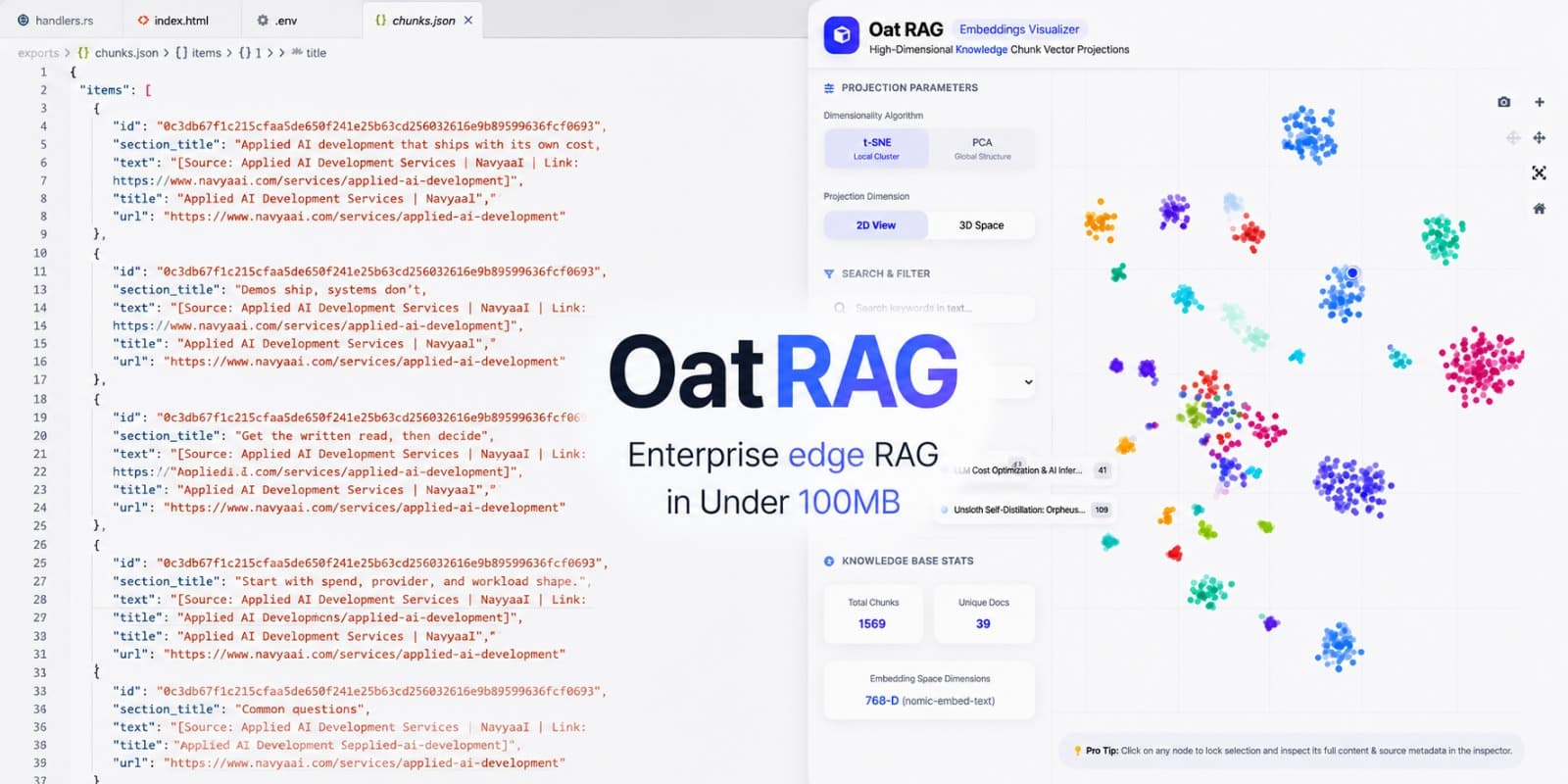
We built the same embedding + rerank gateway in Python, Rust (ONNX), and a split architecture. Rust hit 28% more RPS with 67% less memory, lowering RAG infrastructure cost.

Compress Orpheus-3B TTS with self-knowledge distillation, Unsloth, SNAC tokenization, and LoRA. Smaller adapters reduce serving memory and private AI deployment cost.
Production inference work should show up in unit economics, not just benchmark charts.
Llama 3 70B inference audit
A client running unoptimized Llama 3 70B at roughly 200M tokens per month was carrying low utilization and duplicated GPU spend. After INT8 quantization, KV-cache pruning, and batching tuning, they consolidated from 4 GPUs to 2 while keeping quality within production noise.
42%
cost reduction per million tokens
2.3x
throughput improvement
$47K -> $28K
monthly bill after optimization
Best fit for CTOs, founders, and ML platform leads with production LLM traffic, rising inference spend, or agentic workflows that are hard to forecast.
$20K-$200K/month AI spend, high-volume tokens, RAG, or self-hosting decisions
Andhra Pradesh, India
A company should evaluate self-hosting when usage is predictable, token volume is high, data residency matters, or latency and margin requirements cannot be met through managed APIs. NavyaAI calculates the break-even point before recommending GPUs.
An AI Cost Snapshot is a lightweight review of monthly AI spend, token volume, model mix, RAG or agent workflow shape, latency targets, and deployment constraints. It identifies likely cost leaks before a paid infrastructure audit.
LLM inference cost usually drops through batching, prompt compression, caching, routing, quantization, KV-cache tuning, GPU utilization improvements, and architecture changes that reduce retries and unnecessary agent steps.
Hidden AI costs often include retrieval pipelines, vector databases, orchestration, observability, guardrails, retries, data egress, idle GPU capacity, compliance work, and engineering time.
NavyaAI is best fit for CTOs, founders, and ML platform leads spending roughly $20K-$200K per month on AI APIs, LLM serving, RAG, agents, GPUs, or private AI deployment decisions.